
1.Why 2026 Will Be a Turning Point for Programming Languages
If 2020–2024 was about digital transformation, 2026 will be about execution at scale.
By 2026, software teams won’t just ask “Can we build this?” — they’ll ask:
Can this system scale globally?
Is it secure by default?
Can it integrate AI natively?
Will it survive talent shortages and cloud costs?
This shift is fundamentally changing how organizations choose technology. Programming languages are no longer picked only on syntax or popularity — they’re chosen based on AI readiness, performance, security, cloud-native fit, and long-term sustainability.
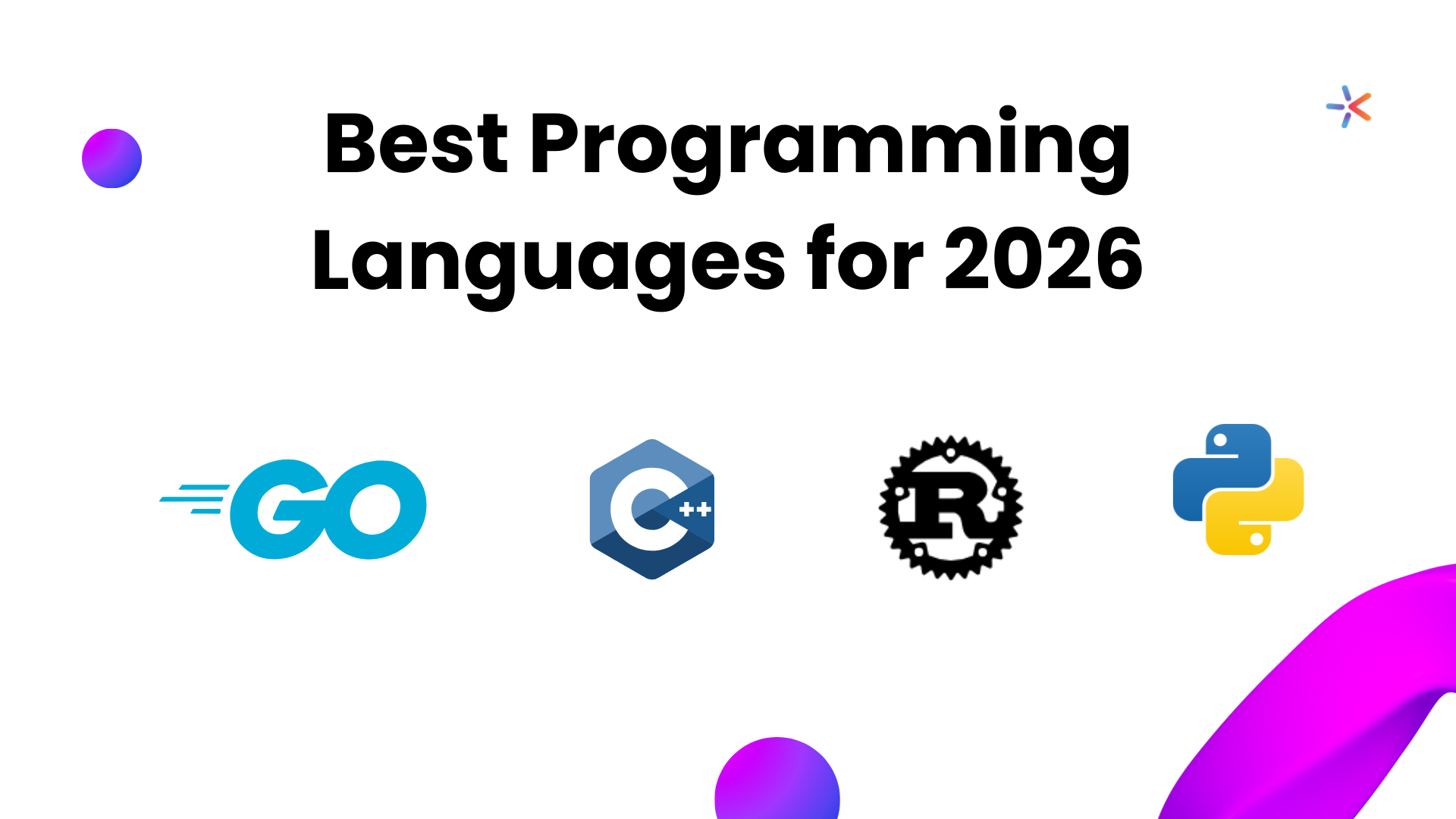
That’s why conversations around the best programming languages 2026 are converging around three clear leaders:
Python → AI, automation, and intelligence layer
Go (Golang) → cloud, microservices, and platform engineering
Rust → secure systems programming for a zero-trust world
Together, they represent the AI-first future of software development.
Why Choosing the Right Programming Language Matters in 2026
Hiring & Talent Economics
By 2026:
Senior engineers will cost more
Teams will be smaller
Productivity per developer will matter more than raw headcount
Languages that reduce bugs, speed up development, and integrate AI tools easily will dominate hiring.
Scalability & Performance Pressure
Modern systems must handle:
Millions of concurrent users
Event-driven architectures
Real-time data pipelines
Edge + cloud workloads
Poor language choices can mean:
Higher cloud bills
Latency bottlenecks
Expensive rewrites
AI Readiness Is No Longer Optional
AI is no longer a feature — it’s an expectation.
Languages must:
Integrate with AI frameworks
Support AI-assisted development
Handle data pipelines efficiently
This is why AI programming languages are becoming a strategic decision, not a developer preference.
Python: The Backbone of AI & Automation
When discussing future programming languages, Python is not declining — it’s cementing itself as infrastructure.
Why Python Dominates the AI-First Era
Python sits at the center of:
Artificial Intelligence
Machine Learning
Generative AI
Data engineering
Automation at scale
If AI is the brain of modern software, Python is its nervous system.
Python + AI Ecosystem (Unmatched)
Python’s dominance comes from its ecosystem, not just syntax:
TensorFlow & PyTorch → deep learning
LangChain & LlamaIndex → LLM orchestration
OpenAI SDKs → GenAI integration
Scikit-learn → classical ML
Pandas & NumPy → data manipulation
This makes python ai development faster than any alternative.
Real-World Adoption
OpenAI → research pipelines, model tooling
Meta → AI research and production ML
Google → internal ML systems and automation
Tesla → data pipelines for autonomous driving
AI startups → MVPs to production at speed
Python Use Cases in 2026
AI-powered SaaS products
Internal automation and DevOps scripts
Data analytics platforms
AI agents and copilots
Backend APIs for AI services
Limitations (And How Python Is Evolving)
Python’s weaknesses are well known:
Slower runtime
GIL limitations
Not ideal for low-level systems
But in 2026:
Python + Rust extensions solve performance bottlenecks
Async Python handles scale better
AI accelerators reduce runtime impact
Python is not becoming faster — hardware and hybrid architectures are making speed less relevant.
Fact 1: Python Is the De-Facto Language for AI Production
Over 70% of AI and machine learning workloads in production are built using Python-based frameworks.
OpenAI, Google, Meta, Tesla, and NVIDIA rely heavily on Python for AI research and deployment
Major GenAI frameworks (PyTorch, TensorFlow, LangChain, OpenAI SDKs) are Python-first
This is why Python remains the most critical AI programming language going into 2026
Go (Golang): Cloud-Native & High-Performance Champion
If Python powers intelligence, Go powers infrastructure.
Go was designed for:
Distributed systems
Cloud-native applications
Concurrent workloads
Platform engineering
Why Go Fits Cloud & Microservices Perfectly
Go’s strengths align exactly with modern backend needs:
Built-in concurrency (goroutines)
Fast compilation
Low memory footprint
Predictable performance
Simple deployment (single binary)
That’s why golang for cloud and microservices isn’t a trend — it’s a standard.
Go in DevOps & Platform Engineering
Go is the hidden engine behind modern cloud tooling:
Docker → written in Go
Kubernetes → Go-native ecosystem
Terraform → infrastructure as code
Prometheus → monitoring at scale
If you touch cloud infrastructure, you’re touching Go.
Enterprise Adoption
Google → internal services and infrastructure
AWS → cloud tooling and SDKs
Uber → high-throughput backend services
Netflix → platform tooling
Go Use Cases in 2026
High-performance APIs
Microservices architectures
Cloud-native platforms
DevOps tooling
Backend systems with predictable scale
Go is becoming one of the most in-demand backend programming languages 2026 because it balances performance and productivity.
Fact 2: Go Powers the Global Cloud Infrastructure Layer
More than 80% of modern cloud-native infrastructure tools are written in Go.
Kubernetes, Docker, Terraform, Prometheus, and etcd are all Go-based
AWS, Google Cloud, and Azure use Go extensively for internal services
Go has become the default choice for cloud, DevOps, and microservices engineering
Rust: The Future of Secure Systems Programming
If there’s one language reshaping how we think about safety, it’s Rust.
Why Security Is Driving Rust Adoption
By 2026:
Cyberattacks are more sophisticated
Regulations are stricter
Memory vulnerabilities are unacceptable
Rust eliminates entire classes of bugs:
Buffer overflows
Use-after-free
Null pointer dereferencing
This makes rust systems programming a strategic advantage.
Why Companies Are Replacing C/C++ with Rust
C and C++ are powerful — but unsafe by default.
Rust offers:
Zero-cost abstractions
Memory safety without garbage collection
Compiler-enforced correctness
That’s why:
Microsoft is rewriting Windows components in Rust
Google is adopting Rust for Android system layers
Amazon uses Rust for security-sensitive services
Rust Use Cases in 2026
Operating systems and kernels
Blockchain & Web3 infrastructure
Cryptography and security tools
Game engines
Embedded systems
Rust vs C++ (At a Strategic Level)
Rust isn’t about replacing C++ everywhere — it’s about:
Reducing long-term risk
Improving code reliability
Enabling fearless refactoring
For secure systems programming, Rust is becoming the default choice.
Fact 3: Rust Is Replacing C/C++ in Security-Critical Systems
Memory-safety bugs account for nearly 70% of critical security vulnerabilities in low-level software.
Microsoft, Google, Amazon, and Mozilla are actively replacing C/C++ components with Rust
Rust eliminates entire classes of memory-related vulnerabilities at compile time
This is driving rapid adoption of Rust for secure systems programming
Comparison Table: Python vs Go vs Rust
| Factor | Python | Go | Rust |
|---|---|---|---|
| Performance | Low–Medium | High | Very High |
| Learning Curve | Easy | Moderate | Steep |
| AI Support | Excellent | Limited | Emerging |
| Best Use Cases | AI, ML, automation | Cloud, microservices | Systems, security |
| Memory Safety | GC-based | GC-based | Compile-time |
| Salary Trends 2026 | High | Very High | Premium |
| Enterprise Demand | Massive | Growing fast | Strategic |
Need expert Python, Go, or Rust developers?
Scale faster with pre-vetted engineers experienced in AI, cloud-native, and secure systems programming.
Programming Language Trends to Watch Beyond 2026
AI-First Development
AI copilots writing boilerplate
Languages optimized for AI integration
Prompt engineering becoming a skill
Secure-by-Default Languages
Memory safety as a baseline
Fewer runtime vulnerabilities
Compliance-driven language choices
Productivity vs Performance Trade-Off
Python for speed of innovation
Go for scalable platforms
Rust for critical systems
The future isn’t one language — it’s polyglot by design.
Which Programming Language Should You Learn or Use in 2026?
For Beginners
Start with Python:
Fast learning curve
Broad use cases
Strong job market
For AI Engineers
Python is non-negotiable:
ML frameworks
GenAI tooling
Research + production
For Backend Developers
Go offers:
Better scalability
Cleaner concurrency
Strong cloud relevance
For System Engineers
Rust is the future:
Secure systems
Long-term career moat
High compensation
Startups vs Enterprises
Startups → Python + Go
Enterprises → Go + Rust
AI-first companies → Python everywhere, Rust where needed
Conclusion: Strategic Takeaway for 2026
There is no single “best” language — only the right language for the right layer.
Python powers intelligence
Go powers scale
Rust powers trust
In the race toward AI-first, cloud-native, and security-driven software, these three languages form the core stack of the future.
If your goal is relevance, resilience, and results in 2026 — build with Python, Go, and Rust.
Building an AI-powered product?
From Python-based AI solutions to Go microservices and Rust-powered secure systems, we design and build production-ready software.