
In today’s fast-paced digital world, businesses are increasingly relying on chatbots to automate customer interactions, streamline operations, and enhance customer support. Chatbots are AI-powered tools that simulate human conversations, offering instant, 24/7 responses to users across websites, social media, and messaging platforms. The growing importance of chatbots lies in their ability to handle repetitive tasks, allowing human agents to focus on more complex issues. This automation not only saves time and resources but also improves the overall customer experience.
While many businesses use off-the-shelf chatbot solutions, custom chatbots offer a more tailored approach. These bots can be built to align specifically with a company’s needs, whether it’s providing personalized customer service, assisting with sales, or automating internal processes. Custom chatbots are highly flexible, designed to integrate seamlessly with existing systems like CRMs, marketing tools, and databases, ensuring optimal performance.
In this blog, we will explore the essential features of a custom chatbot, the step-by-step process of building one, and the associated costs. Understanding these elements will help businesses make informed decisions about whether a custom chatbot is the right investment for them.
What is a Custom Chatbot?
A custom chatbot is an AI-driven tool designed specifically to meet the unique needs of a business. Unlike generic chatbots that offer one-size-fits-all solutions, custom chatbots are tailored to interact with customers in a personalized manner, reflecting the brand’s voice and goals. They can be programmed to perform a range of tasks from answering frequently asked questions (FAQs) to handling complex customer service inquiries or even driving sales.
The major distinction between a custom chatbot and a generic one is its ability to be integrated with various business systems, allowing it to access real-time data and provide personalized responses. Whether it’s pulling data from a CRM to offer individualized recommendations or integrating with a payment gateway to process transactions, custom chatbots are highly flexible and scalable.
What are the types of Chatbots?
Chatbots are classified primarily into two different types –
1. Rule-Based Chatbots
Rule-based chatbots are normally used for simpler applications and processes. These bots can answer questions based on a predefined set of rules that they have been programmed for and cannot operate on a standalone basis. These chatbots are only capable of executing rule-based commands and thus can lead to poor customer experiences.
2. AI Chatbots
AI chatbots are advanced and can handle open-ended queries wisely! They can become smarter over time using NLP and machine learning algorithms. AI-powered chatbot leverages natural language processing services model to learn the context and understand the meaning from the user input.
Let’s explore how a chatbot could unlock new possibilities for your business
Contact Codevian Technologies today, and we’ll show you the game-changing potential of a chatbot tailored just for you.
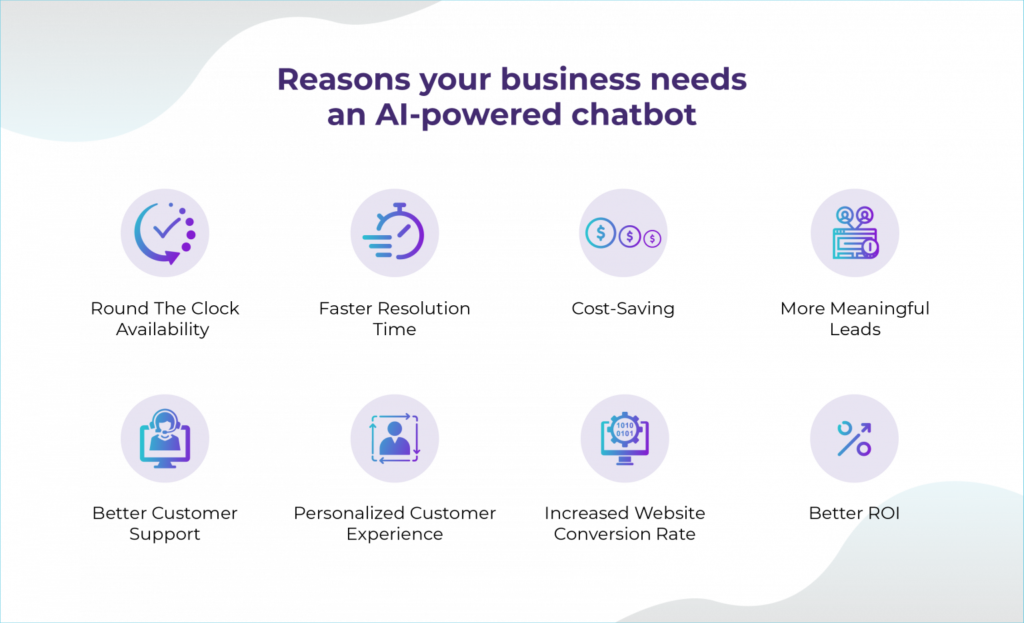
Why does your business need an AI-powered Chatbot?
Still wondering why chatbots are important for your business. Then let’s take a look at the top 10 reasons why chatbots can turn out to be a boon for your business–
- Round the clock availability
Over 50% of customers expect a business to be open 24/7. (Oracle, 2017)
- Faster resolution time
69% of consumers said they would prefer chatbots over human agents for receiving instantaneous responses. (Cognizant, 2019)
- Cost-saving
Smart Chatbots can help businesses save costs up to 30% on their customer support costs. (IBM)
- More meaningful leads
$2.6 trillion in business value will be explored in the coming years in marketing and sales. That implies marketers who deploy AI have the ability to accelerate their companies and careers by building an upper hand with this innovation—particularly with regards to lead generation and conversion. (McKinsey Analytics)
- Better customer support
27% of consumers were unsure if the last customer support interaction they had was with a real person or a chatbot. (PwC)
- Personalized customer experience
71% of consumers would gladly use a bot if it could improve their customer experience. (Conversocial, 2020)
- Increased website conversion rate
57% of executives cite that conversational chatbots enable their websites to provide personalized attention to customers. (Accenture, 2018)
- Better ROI
57% of businesses claimed that chatbot delivers large ROI on minimal investment. (Accenture Digital)
What are the top 10 features that define the best Conversational AI Chatbot?
Chatbots have evolved over time, and so have customers’ expectations. Customers today look for an instant resolution to their problems and they are ready to switch to the other brand if they find the service provider is not actively anticipating their needs. Thus, it becomes necessary for businesses to opt-in for the best conversational AI solution to deliver excellent service and encourage customer loyalty.
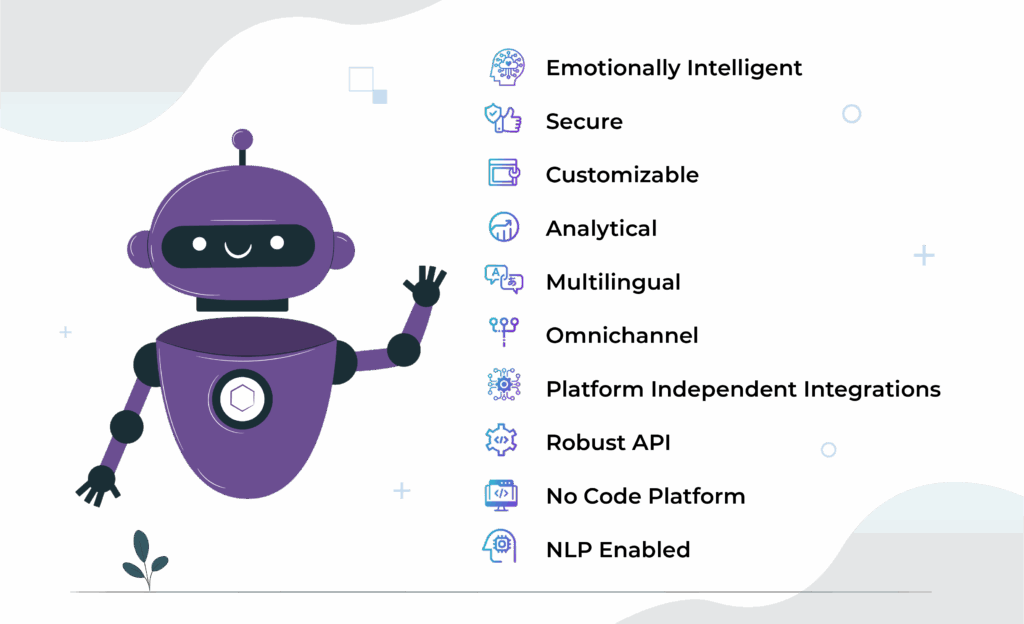
Here are the top 10 features that define the best IVA (intelligent virtual assistant):
- Emotionally intelligent
Chatbots are the primary interface between your business and customers. And thus, it is important to opt-in for a Chatbot that is emotionally intelligent to provide a human-like customer experience. Smart AI virtual assistants can help you build a relationship between your brand and your customers with the help of sentiment analysis. Smart AI-powered chatbots can pick up the underlying emotions from the user input and respond in an appropriate manner.
- Secure
According to the wake of recent studies, AI-powered chatbots are pretty secure. Implementing a bot that is entirely transparent about what data it collects and what is it used for, can help you make most of it. Smart virtual assistants can let your customers have the option to opt-out of data collection only if desired.
- Customizable
The biggest advantage of deploying a customizable chatbot is that it can be trained the way your customers want it to be. The customizable smart chatbots can reap insights and provide customer support that suits the audience.
- Analytical
The analytical chatbot can help you capture and analyze your customer support data effortlessly. It can let you curate reports for quick insights. Implement a chatbot that can help you create reports on the go without having to rely on a data analyst or any external business intelligence tools.
- Multilingual
Communicating with your customers in their preferred language is the key to achieve wider reach globally. Don’t let language be a barrier for your customer support. Increase your reach and boost communication globally with multilingual engagement using a chatbot that supports multiple languages.
- Omnichannel
The most popular messaging apps like WhatsApp, Facebook, Twitter, Telegram have become the means of community and business survival. In this digital age, not being present on social media is like missing the opportunity of reaching out to 70% of your potential customers. It is important to go for the chatbot service provider that allows you to provide customer support across all touchpoints regardless of channel. You must look for the chatbot that can power conversations across the most used channels to cater to the most preferred gateway for your customers to connect and engage with your business.
- Platform independent integrations
An intelligent virtual assistant (IVA) allows you to integrate with your preferred 3rd-party applications like Qlik, Salesforce, Tableau, Google Sheets, and more. An enterprise-grade integration framework can help you seamlessly connect with virtually any system by providing native integrations and custom integrations.
- Robust API
APIs allow chatbots to fetch user information from different applications. Having Robust chatbot APIs are capable of providing advanced functionality, along with documentation, data, and services. A strong chatbot API can help you keep customer engagement intact and create an unprecedented experience. It can enable solutions to become flexible and easy to use and control.
- No code platform
You may think that building an intelligent chatbot requires a lot of effort. But what if we tell you that with a no-code bot-builder platform, you can easily build a smart virtual assistant without writing a single line of code with minimal effort! Yes, a no-code platform bot-builder can make your organization more self-sufficient as you no longer have to depend on your technical teams to deploy the bot.
- NLP-Enabled
An NLP-enabled chatbot allows incredibly effective and intuitive communication between you and your customers. The NLP-enabled automated platform allows you to provide constructive support to your customers throughout their journey. This may result in improved consumer satisfaction, business productivity, and profitability.
The Process of Building a Custom Chatbot
Building a custom chatbot is a strategic process that combines business understanding, technology selection, user experience design, and continuous optimization. A well-planned chatbot development process ensures that the chatbot delivers real value, improves engagement, and aligns with long-term business goals. Below is a step-by-step guide to building a custom chatbot successfully.
1. Define the Purpose and Goals
The first step to build a custom chatbot is identifying its purpose. Businesses must determine the primary problem the chatbot will solve—whether it’s customer support automation, lead generation, sales assistance, appointment booking, or internal process automation. Clear objectives help shape chatbot functionality and conversation design.
Once the purpose is defined, setting measurable Key Performance Indicators (KPIs) is essential. Common KPIs include response accuracy, conversation completion rate, customer satisfaction score, lead conversion rate, and average resolution time. These metrics allow businesses to evaluate chatbot performance and ensure the custom chatbot meets expectations.
2. Choose the Right Platform and Technology
Selecting the right platform plays a crucial role in the chatbot development process. Popular chatbot development platforms include Google Dialogflow, Microsoft Bot Framework, Rasa, and IBM Watson Assistant. Each platform offers unique capabilities, such as advanced NLP, scalability, or on-premise deployment options.
At this stage, businesses must also decide between rule-based chatbots and AI-powered chatbots. Rule-based bots follow predefined scripts and are suitable for simple tasks, while AI chatbots use machine learning and NLP to understand complex user queries and adapt over time.
Technology selection includes NLP engines, machine learning models, APIs, and integration tools that allow seamless AI chatbot integration with existing systems such as CRMs, ERPs, and analytics platforms.
3. Design User Flow and Conversations
A successful custom chatbot relies on intuitive conversation design. Creating smooth, natural interactions requires mapping user journeys and defining conversation paths for different scenarios. This includes greeting messages, intent recognition, fallback responses, and escalation to human agents when needed.
User flow design ensures that the chatbot guides users logically toward their goals without confusion. Visual flowcharts and conversation trees are often used to plan interactions, ensuring consistent tone and clarity across all chatbot responses.
4. Build and Train the Chatbot
Once the design is finalized, development begins. Developers build the chatbot logic, integrate APIs, and configure backend systems. Training the chatbot involves feeding it sample data, real user queries, and scripted conversations so it can recognize user intent accurately.
Testing is a critical phase in the chatbot development process. The chatbot is tested for response accuracy, edge cases, and error handling. Continuous testing helps refine answers, improve fallback messages, and eliminate conversation gaps.
5. Integration and Deployment
After testing, the custom chatbot is integrated into the target platforms such as websites, mobile apps, WhatsApp, Facebook Messenger, or internal dashboards. Proper AI chatbot integration ensures real-time data exchange between the chatbot and business systems.
Deployment is followed by performance monitoring to track KPIs, user engagement, and response accuracy. This phase helps identify early issues and opportunities for improvement.
6. Ongoing Maintenance and Optimization
Building a custom chatbot is not a one-time task. Continuous maintenance is required to keep the chatbot relevant and effective. Businesses must update conversation flows, retrain NLP models, and optimize responses based on user feedback and analytics.
Regular optimization improves accuracy, expands chatbot capabilities, and ensures long-term performance. Fine-tuning AI models allows the chatbot to evolve with changing customer behavior and business needs.
This structured approach to the chatbot development process ensures that businesses create scalable, intelligent, and high-performing chatbot solutions that deliver measurable results.
Cost of Building a Custom Chatbot
| Cost Component | Simple Rule-Based Chatbot | AI-Powered Chatbot (NLP, AI) |
|---|---|---|
| Development Costs | ||
| Platform Subscription | $0 – $500/month (depending on platform) | $50 – $1000+/month (advanced features) |
| Development Team (Hourly Rate) | $30 – $150/hour (depending on location) | $30 – $150/hour (depending on location) |
| Testing & QA | 10-15% of total development cost | 10-15% of total development cost |
| Feature Complexity | ||
| Natural Language Processing (NLP) | +30-50% cost increase | Included in development cost |
| AI Integration | Not applicable | +40-60% cost increase |
| Integrations (CRM, Payment, etc.) | Basic integration (e.g., FAQs) | Advanced integrations (CRM, ERP, Payment gateways) |
| Maintenance Costs (Annual) | ||
| Updates & Enhancements | $500 – $2,000 | $1,000 – $5,000 |
| Training & Optimization | N/A | $1,000 – $10,000 |
| Performance Monitoring | $100 – $500/month | $500 – $1,000/month |
| Total Estimated Development Cost | $3,000 – $10,000 | $10,000 – $50,000+ |
| Outsourcing vs In-House | ||
| Outsourcing (Agency) | Recommended for lower budgets | Ideal for specific expertise |
| In-House Development | Less control, higher overhead | Greater control, long-term ROI |
Case Studies of Successful Custom Chatbots
1. Sephora – E-commerce and Customer Support
Beauty retailer Sephora implemented a custom chatbot named Sephora Virtual Artist to enhance its e-commerce and customer support capabilities. This AI-powered bot allows users to virtually try on makeup, get personalized product recommendations, and book in-store appointments. By integrating the chatbot into their mobile app and website, Sephora improved customer engagement and increased conversions.
Results:
Increased conversion rate by 11% for customers who interacted with the chatbot.
Reduced customer service response time by 30%, enabling quicker assistance for customers.
Improved customer satisfaction with personalized shopping experiences.
2. Miu Miu – Lead Generation and Engagement
Luxury fashion brand Miu Miu used a custom chatbot for lead generation and personalized marketing. The chatbot engages users by offering style advice and collecting customer data to build a more refined marketing strategy. The bot was integrated into the brand’s Instagram and website, where it helped convert visitors into potential leads by offering exclusive content and promotions.
Results:
Boosted lead generation by 25% through personalized interactions.
Increased engagement by 40% on social media platforms like Instagram.
Achieved a 40% reduction in the need for human customer service interventions by automating common inquiries.
These case studies show how custom chatbots can drive real business results by enhancing customer experience, reducing response times, and increasing conversions. Whether it’s through e-commerce, lead generation, or customer support, chatbots offer significant ROI through automation and personalization.
Conclusion
Building a custom chatbot offers significant advantages for businesses looking to streamline operations, enhance customer engagement, and improve service efficiency. With advanced features like Natural Language Processing (NLP), AI integration, and multilingual support, custom chatbots can deliver tailored, personalized experiences that meet the unique needs of your business. The process of creating a chatbot involves clearly defining its purpose, selecting the right platform and technology, designing user flows, and ongoing maintenance to ensure optimal performance.
While the initial development costs for a custom chatbot can vary based on complexity, the long-term ROI is undeniable. From reducing customer response times and improving lead generation to automating repetitive tasks and providing actionable insights, chatbots can significantly boost business efficiency and customer satisfaction.
At Codevian Technologies, we specialize in creating powerful, AI-driven chatbots tailored to your business needs. Whether you’re looking to streamline customer support, generate leads, or boost sales, our expertise can help you build a chatbot that delivers tangible results.
Ready to take your business to the next level?
Contact us today to discuss how a custom chatbot can enhance your customer experience, drive sales, and optimize your operations.